
Why Most Brands Are Becoming Visible But Forgettable
Modern brands are suffering from a strange paradox. They are becoming easier to see and harder to remember.
Every day, consumers scroll past thousands of ads, reels, campaigns, influencer collaborations, emailers, sponsored posts, and AI-generated content pieces. Brands are publishing more than ever before. Marketing budgets are expanding. Visibility metrics are rising. And yet, something feels off. People are seeing brands constantly but forming fewer emotional connections with them.
Scroll through social media for ten minutes, and you’ll notice the pattern immediately. Similar aesthetics. Similar captions. Similar storytelling structures. Similar “authentic” content. Even the rebellion feels algorithm-approved now. Some brands dominate feeds for weeks. But very few stay in your memory for years. That is the real branding crisis modern businesses are facing.
Not invisibility. Forgettability.
And honestly, many companies do not realise how serious this problem has become because visibility metrics often create a false sense of success. High reach feels impressive. Strong impressions look reassuring. Engagement spikes appear exciting. But here is the uncomfortable truth.
Visibility alone does not build brand memory.
People may interact with your content today and completely forget your brand tomorrow. That growing disconnect between exposure and emotional remembrance is what we call the Visibility Memory Gap. And right now, it is quietly reshaping advertising, digital marketing, and strategic communication globally.
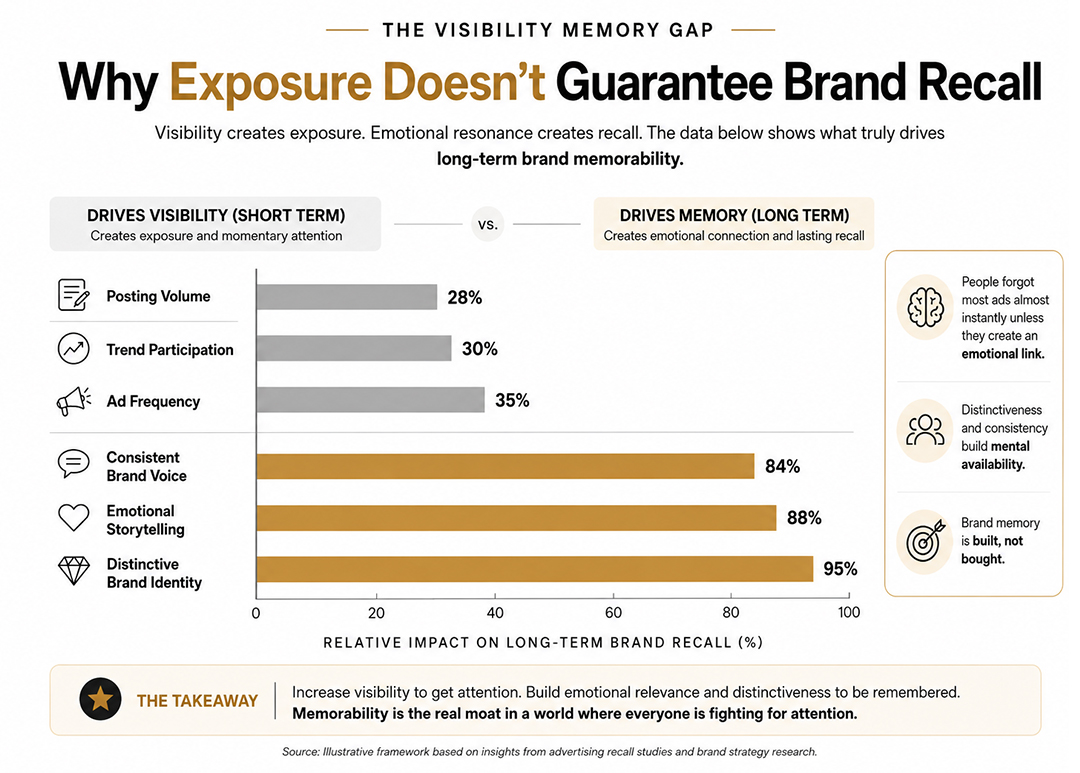
The comparison makes one thing clear: increasing visibility can generate attention, but memorability depends on emotional and strategic differentiation. Brands that invest only in exposure often become familiar for a moment, while brands that build distinctive emotional associations remain memorable for years.
The Visibility Memory Gap Is Growing Faster Than Most Brands Realise
The internet rewards constant visibility. Algorithms reward:
- Frequency
- Fast reactions
- High-volume publishing
- Trend participation
- Short-term engagement
- Continuous activity
As a result, brands feel pressured to remain active every single day.
Post more. React faster. Stay relevant. Join trends immediately. At first glance, this strategy makes sense. More visibility should naturally create a stronger brand presence.
Except that human psychology does not work like social media algorithms. Consumers do not remember brands simply because they appeared repeatedly on screen. They remember brands that created emotional relevance. And emotional relevance cannot be automated at scale.
Several advertising recall studies over the years have consistently shown that people forget most digital ads almost instantly unless they trigger emotional association, cultural relevance, or distinctive memory patterns. That distinction changes everything.
Visibility creates exposure. Emotional resonance creates recall. One drives temporary attention. The other builds long-term brand equity. Unfortunately, many modern businesses are heavily optimising for the first while slowly weakening the second.
The Internet Has Become Loud but Emotionally Flat
Consumers today experience unprecedented levels of content saturation.
Instagram reels. YouTube ads. Brand podcasts. LinkedIn thought leadership. Email marketing campaigns. AI-generated visuals. Influencer collaborations. Performance-driven ad funnels. The volume is relentless.
Naturally, audiences have adapted by becoming emotionally selective. People now filter communication within seconds. Subconsciously, they ask:
Does this feel human? Have I seen this before? Is this emotionally relevant? Does this sound real? Is this worth my attention? If the answer feels uncertain, they scroll instantly. And honestly, most brand communication today feels painfully interchangeable.
The internet has become aesthetically crowded but psychologically empty. That is why many businesses struggle with weak brand recall despite massive digital visibility. Their communication generates exposure but fails to create memorability. And memorability is where real branding begins.
Algorithm Culture Is Quietly Destroying Brand Distinctiveness
One of the biggest reasons behind forgettable branding is algorithm-driven behaviour. Social platforms reward familiarity because predictable formats often perform better statistically. Over time, brands begin imitating whatever appears to be working online. You can see it everywhere:
- The same visual language
- The same “relatable” humour
- The same storytelling templates
- The same aesthetic minimalism
- The same trending sounds
- The same performative authenticity
Eventually, brands stop communicating like themselves and start communicating like the algorithm. This creates what we call Algorithmic Identity Collapse. That happens when brands adapt so aggressively to digital trends that they slowly erase their own recognisable personality.
Once identity weakens, memory weakens too. Some brands are producing so much content that they are accidentally erasing themselves. That may sound harsh. But it is happening across industries. Fashion brands increasingly look interchangeable. Luxury communication feels over-curated. Hospitality marketing sounds repetitive. Corporate branding often feels emotionally sterilised.
Everyone is visible. Very few feel distinctive.
The strongest brands in history were never built through constant reactive communication alone. They were built through emotional consistency, strategic clarity, and recognisable identity systems.
Even globally respected luxury brands understand this deeply. Many intentionally avoid excessive visibility because overexposure can weaken perceived distinctiveness. They protect their emotional positioning carefully instead of chasing every trend cycle online. That level of restraint is strategic.
Performance Marketing Is Winning Clicks but Losing Emotional Depth
Now, this conversation needs balance because performance marketing is essential. Modern businesses need measurable growth systems. Paid advertising, targeting, analytics, and conversion optimisation are powerful tools. But problems begin when performance marketing becomes the entire communication philosophy. Because platforms optimise for clicks. Human beings connect through emotion. And those are not always aligned.
This is exactly why some brands generate impressive traffic numbers while remaining culturally forgettable. Their communication becomes:
- Hyper-optimised
- Data-heavy
- Conversion-obsessed
- Creatively repetitive
- Emotionally predictable
Consumers stop remembering the brand itself. They only recognise the marketing structure. You have probably seen the pattern:
- Aggressive hook
- Problem amplification
- Urgency trigger
- Fast CTA
- Repeat endlessly
Initially, these systems perform well. Over time, audiences become emotionally numb to them. In fact, younger audiences are already showing strong resistance toward excessively engineered communication. Gen Z consumers especially value emotional honesty, cultural awareness, conversational language, and human energy more than polished corporate perfection. That shift is changing digital marketing rapidly. People still purchase through logic sometimes. But they almost always remember through feeling.
Consumers Have Developed a Strong Radar for Fake Authenticity
This is one of the most fascinating consumer behaviour shifts happening right now. Audiences can instantly sense performative branding. Especially digitally native audiences. People know when:
- Relatability is manufactured
- Empathy is scripted
- “Community” is performative
- Emotional storytelling is artificial
- Social awareness is strategically staged
And because consumers have become emotionally sharper online, brands can no longer survive on surface-level authenticity. The audience has evolved. Today’s consumers want:
- Perspective
- Emotional realism
- Human communication
- Cultural intelligence
- Clear identity
- Genuine storytelling
Ironically, this is why many raw creator videos outperform heavily polished brand campaigns. Perfection no longer guarantees trust. Humanity does. And this shift matters because branding is no longer just visual positioning. It is behavioural positioning too. Consumers are observing how brands speak. What brands prioritise? How do brands react culturally? Whether communication feels emotionally honest. Modern audiences are not simply buying products anymore. They are evaluating emotional credibility.
Why Brand Recall Matters More Than Reach
Many businesses still obsess over:
- Impressions
- Reach
- Engagement
- View counts
- Click-through rates
- Follower growth
These metrics matter. Of course they do. But they are incomplete. Because the real question is much deeper: What do people actually remember after encountering your brand? That is where brand recall becomes critical. Strong brand recall means consumers remember:
- Your emotional tone
- Your personality
- Your communication style
- Your positioning
- Your worldview
- Your emotional energy
Weak brands disappear mentally the moment the content ends. Strong brands remain psychologically present long after exposure. And in a digital economy overflowing with content, mental availability is becoming one of the most valuable branding assets a company can build. Because consumers rarely choose based on visibility alone. They choose based on familiarity, emotional association, trust, remembered experience, and perceived identity.
That is branding psychology at work.
Most Brands Are Creating Content Without Building Identity
This is where many businesses unknowingly weaken themselves. They focus heavily on content production but neglect identity architecture. And there is a major difference between the two.
Content asks: “What should we publish today?”
Strategic brand identity asks: “What should people consistently feel when they encounter us?”
Without a clear identity system, communication becomes fragmented.
One week playful. Next week is corporate. Then luxury-focused. Then sarcastic. Then hyper-sales-driven. Eventually, consumers stop forming clear emotional associations altogether. And confused brands rarely become memorable brands.
The businesses winning today usually operate from stronger strategic foundations, with:
- Clear brand positioning
- Consistent communication psychology
- Distinctive storytelling systems
- Recognisable tone of voice
- Long-term narrative thinking
- Human-centred communication strategy
They are not merely producing content. They are building perception intentionally. That difference is massive.
Human-Centred Storytelling Is Becoming a Competitive Advantage
As AI-generated communication floods the internet, emotionally intelligent storytelling is becoming dramatically more valuable. People are exhausted by robotic brand language. They crave:
- Nuance
- Imperfection
- Emotional texture
- Conversational communication
- Human perspective
- Real insight
This explains why founder-led communication is growing globally across industries. Audiences connect more deeply when messaging feels identifiable, emotionally grounded, and genuinely human.
That does not mean brands should abandon strategic structure or professionalism. It means they should stop sounding emotionally artificial. Because modern consumers are not just evaluating products anymore. They are evaluating:
- Energy
- Intent
- Emotional intelligence
- Behaviour
- Cultural sensitivity
- Human depth
And the brands communicating with honesty, clarity, and emotional realism are becoming significantly more memorable than the brands endlessly chasing algorithmic perfection.
So What Makes a Brand Truly Unforgettable Today?
The brands people remember deeply usually share a few critical qualities.
1. They Know Exactly Who They Are
Strong brands do not shapeshift constantly to match internet trends. Their communication feels emotionally grounded and recognisable.
2. They Build Emotional Associations
People remember feelings faster than information. Great branding understands consumer psychology deeply.
3. They Prioritise Distinctiveness
Their tone, storytelling, and communication style feel unmistakably specific. Not interchangeable.
4. They Communicate Like Humans
Not like automated corporate templates. Human communication creates stronger emotional retention.
5. They Think Long-Term
They understand that meaningful brand equity cannot be built through temporary engagement spikes alone. Memorability requires consistency.
The Future Belongs to Brands People Actually Feel Something For
The future of advertising, digital marketing, and strategic communication will belong to brands that understand emotional relevance better than visibility mechanics alone. Because consumers are changing rapidly. People are becoming:
- More selective
- More emotionally aware
- More sceptical
- More culturally intelligent
- More resistant to manufactured communication
As a result, brands can no longer survive through exposure alone. They need:
- Strategic positioning
- Emotional storytelling
- Distinctive communication systems
- Behavioural insight
- Human-centred brand identity
- Long-term narrative clarity
The brands producing the most content are not necessarily building the strongest identities. In many cases, they are weakening their distinctiveness by trying too hard to remain constantly visible. And that is the irony modern marketing rarely discusses openly.
Final Thoughts
Most brands today are not struggling because they lack visibility. They are struggling because they lack emotional memorability. Somewhere along the way, marketing became obsessed with exposure while forgetting the deeper psychology of human connection. But people do not build relationships with algorithms.
They build relationships with meaning.
At Page 29, this shift sits at the heart of how we approach branding, advertising, and strategic communication. We believe visibility without emotional identity is unsustainable. Modern businesses need more than content calendars, ad spends, and trend participation. They need strategic clarity, distinctive storytelling, behavioural insight, and communication systems people genuinely connect with.
In the end, people rarely remember the brands that interrupted them. They remember the brands that understood them. They remember the ones that felt unmistakably human.