
Why Strategic Communication Is Becoming More Important Than Advertising
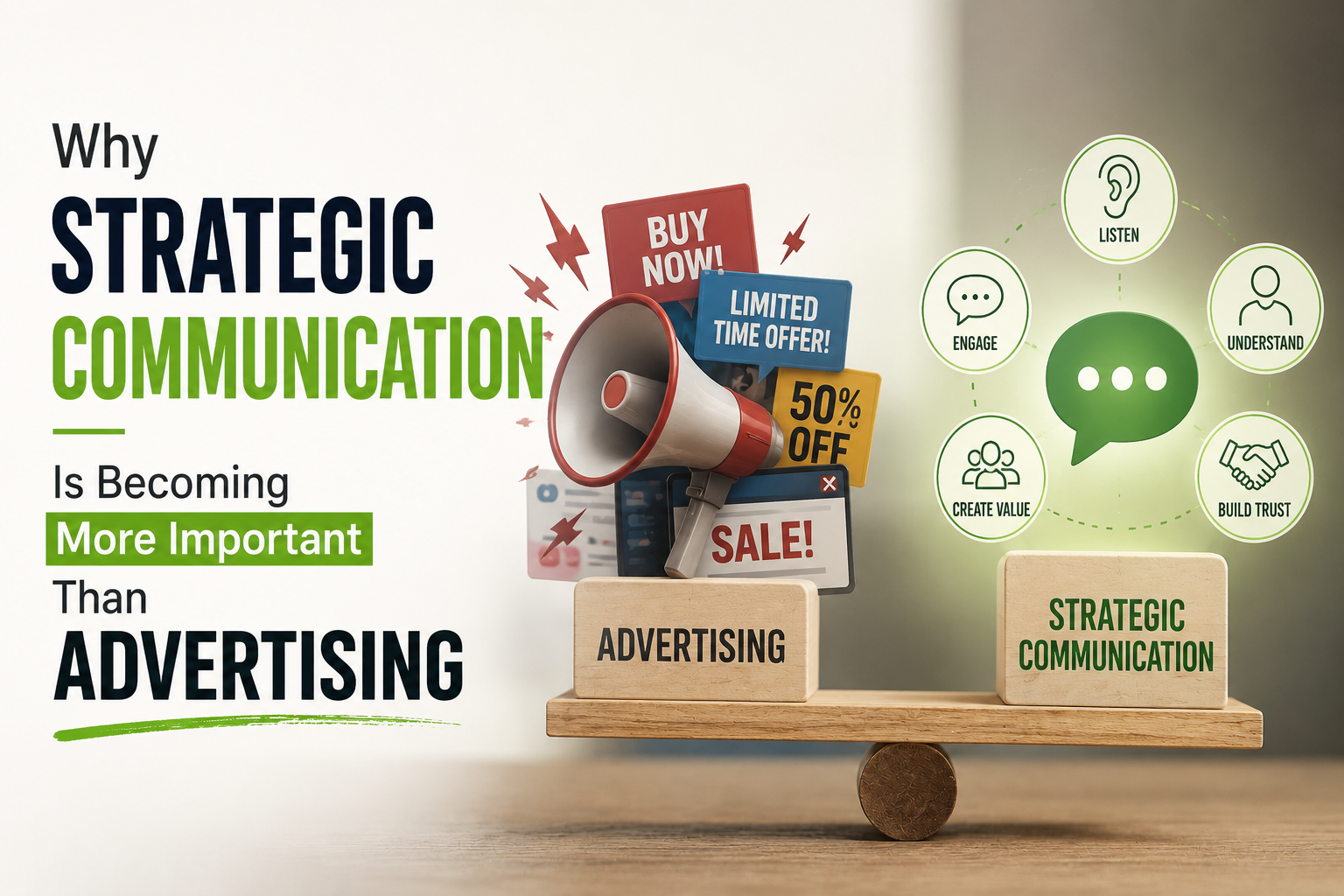
The Brands Winning Today Are Not Competing for Attention. They’re Competing for Belief.
A few years ago, a global company faced a serious reputational challenge. Its products were strong. Its advertising was award-winning. Its media spending was among the highest in its category. Yet customer sentiment was declining. Employee confidence was weakening. Investors were becoming cautious. The company responded the way many organisations do.
- It increased marketing spend
- It launched new campaigns
- It amplified its messaging.
Nothing changed. Why? Because the problem was never visibility. The problem was credibility. The company didn’t have an awareness gap. It had a trust gap. That distinction is becoming one of the most important realities in modern business.
For decades, organisations competed for attention. Today, they compete for belief. And belief cannot be purchased the way media space can. It must be earned.
This is why strategic communication is becoming more important than advertising. Not because advertising has stopped working. But because advertising alone is no longer enough.
In a world overflowing with information, trust has become the most valuable competitive advantage a brand can possess. The organisations that understand this shift are building stronger reputations, deeper stakeholder relationships, and more resilient businesses. The organisations that don’t are discovering a difficult truth: Being seen is not the same as being believed.
The Trust Deficit Paradox
Here is one of the defining paradoxes of our era. Organisations are communicating more than ever before. Yet audiences trust them less than ever before. Brands have access to: more channels, more platforms, more content, more technology, more audience data.
And still, trust continues to decline. Why?
Because communication volume is growing faster than communication quality. Everyday, consumers encounter advertisements, sponsored content, influencer partnerships, corporate announcements, promotional campaigns or AI-generated content. The result is not greater confidence. The result is greater scepticism. People have become highly effective at filtering noise.
The modern consumer does not suffer from an information shortage. They suffer from a credibility shortage. This is where many organisations make a critical mistake. They assume they have a communication deficit.
In reality, most have a credibility deficit. More messaging rarely solves a trust problem. Better communication does.
The Real Reason Advertising Is Losing Influence
Many marketers argue that advertising is becoming less effective because people are overwhelmed with content. While that is true, it is not the primary reason.
The deeper shift is behavioural. People increasingly trust networks more than institutions. Historically, institutions controlled information.
Today, audiences verify information through networks. Before making decisions, consumers consult:
- Online reviews
- Industry experts
- Professional communities
- Employees
- Creators
- Independent analysts
- Friends and family
People no longer ask: “What is this company saying?” Instead, they ask: “What do trusted people think about this company?” That single behavioural shift has transformed the role of communication.
Advertising communicates claims. Strategic communication shapes conversations. And conversations shape perception.
From the Attention Economy to the Trust Economy
To understand where communication is heading, we must first understand how influence has evolved.
The Attention Economy
For decades, visibility was the ultimate competitive advantage. The brands with the largest advertising budgets often dominated their categories. The formula was simple. Reach more people. Generate more impressions. Increase awareness. And growth followed.
The Information Economy
The internet democratised information. Consumers gained access to reviews, comparisons, research, and alternative perspectives. Advertising still mattered. However, information increasingly influenced decision-making.
The Trust Economy
Today, information is abundant. Trust is scarce. People can access unlimited information within seconds. The challenge is no longer finding information. The challenge is determining what deserves belief. Consequently, trust has become one of the most valuable assets in business.
Brands are no longer competing for exposure. They are competing for confidence. And confidence is earned through strategic communication.
The Belief Gap: The Hidden Challenge Holding Brands Back
At Page 29, we call this challenge the Belief Gap.
What Is the Belief Gap?
The Belief Gap is the distance between:
- What an organisation wants stakeholders to believe.
- What stakeholders actually believe.
This gap determines whether communication succeeds or fails.
A company may position itself as innovative. Customers may perceive it as outdated. A leadership team may communicate transparency. Employees may experience inconsistency. A business may claim to be customer-centric. Customers may feel ignored.
No advertising campaign can close this gap.
Only communication that aligns words, actions, culture, and stakeholder experience can. The strongest organisations continuously reduce the distance between perception and reality. That is how trust is built.
The Trust Pyramid: How Influence Is Actually Created
Trust develops in stages. Understanding those stages explains why communication has become so valuable.
Level 1: Visibility
People become aware of your existence. Advertising excels here.
Level 2: Familiarity
People understand what you offer. Marketing strengthens recognition.
Level 3: Credibility
Communication provides proof, expertise, and transparency. People begin taking your organisation seriously.
Level 4: Trust
Consistency creates confidence. People begin believing you.
Level 5: Advocacy
Trust transforms stakeholders into advocates. Influence becomes self-sustaining. Advertising accelerates visibility. Strategic communication creates belief.
And belief creates long-term value.
The Reputation Multiplier: How Trust Becomes Growth
Trust is often described as a soft metric. That description is outdated. Trust creates measurable business outcomes. The relationship can be understood through the Reputation Multiplier.
Communication → Trust → Reputation → Influence → Growth
Strategic communication builds trust. Trust strengthens reputation. Reputation creates influence. Influence drives growth. When this cycle functions effectively, organisations often experience:
- Lower customer acquisition costs
- Higher retention rates
- Greater pricing power
- Stronger investor confidence
- Improved employee attraction and retention
- Increased stakeholder loyalty
Unlike advertising, which often stops generating value when spending stops, trust compounds over time. That is why trust has become one of the most valuable economic assets in business.
Why Leadership Communication Matters More Than Ever
Another major shift is transforming modern influence. People increasingly trust people more than logos. Consumers want to hear from Founders, CEOs, Subject matter experts, and Industry leaders
This makes leadership communication a strategic advantage. One of the strongest examples is Microsoft under Satya Nadella.
Before Nadella became CEO, Microsoft was often viewed as bureaucratic, internally fragmented, and increasingly disconnected from the future of technology. The transformation that followed was not driven by advertising. It began with communication.
Nadella consistently communicated themes such as Growth mindset, Continuous learning, Collaboration, Innovation, and Empathy
Those ideas reshaped culture internally. They strengthened employee confidence. They improved investor perception. They repositioned Microsoft as a forward-looking organisation.
The communication came first. The perception shift followed. The lesson is clear. Leadership communication is no longer a public relations exercise. It is a business strategy.
AI Is Not Creating a Content Crisis. It’s Creating an Authenticity Premium.
Artificial intelligence has changed the economics of content creation. Today, organisations can generate:
- Articles
- Campaigns
- Emails
- Reports
- Social content
- Marketing assets
Within minutes.
Many assume this creates a communication advantage. The reality is more nuanced.
AI is making content abundant. And abundance reduces differentiation. This creates a new market dynamic. Authenticity becomes a premium product.
For decades, information was valuable because it was scarce. Today, authenticity is valuable because it is scarce. The organisations that stand out will not necessarily create the most content. They will create the most credible content.
Advertising Is Not Dying. It Is Changing Roles.
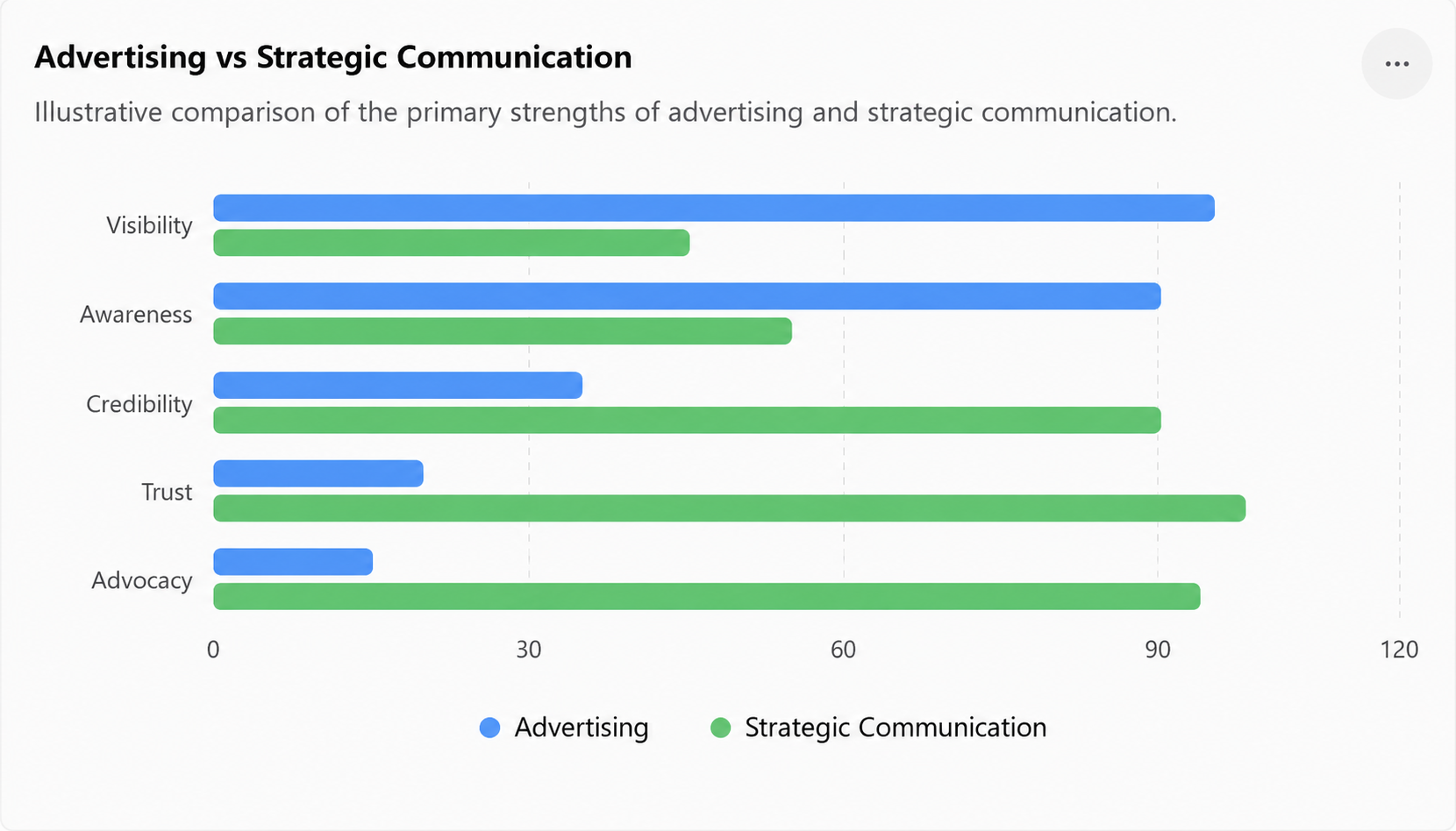
A common misconception is that strategic communication is replacing advertising. That is not true. Advertising remains enormously important. However, its role is evolving. Historically, advertising helped build trust.
Today, advertising increasingly amplifies trust that already exists. This distinction matters. Advertising can introduce a brand. Strategic communication validates it. Advertising can generate awareness. Strategic communication creates confidence. Advertising can attract attention. Strategic communication sustains belief.
The future belongs to organisations that integrate both disciplines effectively.
Why Strategic Communication Is Now a Boardroom Issue
For years, communication was viewed primarily as a marketing function. That perspective is becoming outdated.
Communication today influences:
- Revenue
- Reputation
- Investor confidence
- Employee engagement
- Regulatory relationships
- Market value
More importantly, communication has become a critical risk management function. Poor communication can destroy value faster than many operational failures. A crisis handled poorly can damage:
- Customer trust
- Investor confidence
- Employee morale
- Brand reputation
Within days.
In contrast, organisations with strong communication capabilities often recover faster and preserve stakeholder confidence during difficult periods. This is why communication increasingly belongs in boardroom conversations. It creates value. But just as importantly, it protects value.
Reputation Is No Longer an Outcome. It Is Infrastructure.
Many organisations still treat reputation as something they build after achieving success. The reality is often the opposite. Reputation creates success.
A strong reputation can:
- Attract talent before recruitment begins
- Generate opportunities before outreach starts
- Build investor confidence before presentations occur
- Create trust before sales conversations happen
Reputation reduces friction. It creates leverage. And leverage creates a competitive advantage. The organisations that understand this invest in reputation strategically rather than reactively.
Why Page 29 Is Built for the Trust Economy
Most agencies help brands become visible. Page 29 helps organisations become believable. There is a significant difference. The challenge facing modern organisations is not creating more content. It is closing the Belief Gap between intention and perception.
Through strategic branding, communication, reputation management, stakeholder engagement, executive communication, and integrated marketing, Page 29 helps organisations align what they say with what stakeholders actually experience.
The goal is not simply awareness. It is influence. Because influence drives growth. Influence strengthens reputation. Influence attracts opportunities. And influence creates sustainable competitive advantage.
In a world where trust has become the ultimate currency, helping organisations earn and sustain belief is more valuable than ever.
Final Thoughts
Every organisation leaves an impression. Every leader creates a narrative. Every action communicates something. The question is not whether stakeholders will form opinions. They will.
The real question is whether those opinions will be shaped intentionally or accidentally.
For decades, scale created power. Then visibility created power. Today, credibility creates power.
Advertising still matters. It creates awareness. It generates attention. It introduces brands to the world. But attention alone can no longer carry the weight of reputation. That responsibility belongs to strategic communication. Because in a world where everyone can create content, the organisations that earn trust will ultimately earn influence. And the organisations that earn influence will shape industries, attract opportunities, build stronger relationships, and create enduring brands.
Advertising may help people notice you. Strategic communication gives them a reason to believe you. And long after campaigns end, belief is what people remember.